How to Control Your Emotions on the Tennis Court
Anger on court is not a character problem. It's an attention problem. Learn how to refocus.
Many tennis players get angry, frustrated or lose their balance during matches. Getting angry too quickly. Cursing. Throwing rackets. Complaining. Not being able to deal with being behind. At 359.tennis we see this daily — and we know: this is not a character problem. This is an attention problem. Also read our blog about mental training and focus and how to deal with match pressure.
"Anger is not the problem. Losing your focus is the problem."
What causes anger and frustration on the tennis court?
Anger almost always arises because players focus on things they cannot fully control.
- •The score — 'I need to win this point'
- •The opponent — 'They play so annoying'
- •In or out — 'That ball was in!'
- •Mistakes — 'Another double fault'
- •Spectators — 'Everyone is watching'
- •Expectations — 'I should be winning'
How do attention circles relate to your emotions?
In sport psychology we work with attention circles. Divide everything into what you can control and what you cannot.
- •Circle of control: effort, attitude, breathing, focus, tactical plan, response to mistakes
- •Circle of influence: energy level, atmosphere, body language
- •Circle of concern: weather, opponent, result, umpire, spectators
How can you redirect your attention to stay calm?
Mental training means learning to consciously redirect your attention to your task. Point by point.
- •Breathing: take 3 calm breaths at changeover. 4 counts in, 4 counts out
- •Play with a plan: choose one task before each point
- •One task per point: focus on the process, not the result
- •Focus word: choose one word that brings you back ('calm', 'patience', 'plan')
- •Friendly eyes: relax your face. A soft gaze changes your entire posture
- •Reset body language: walk upright, shoulders back
How can parents help their child manage emotions?
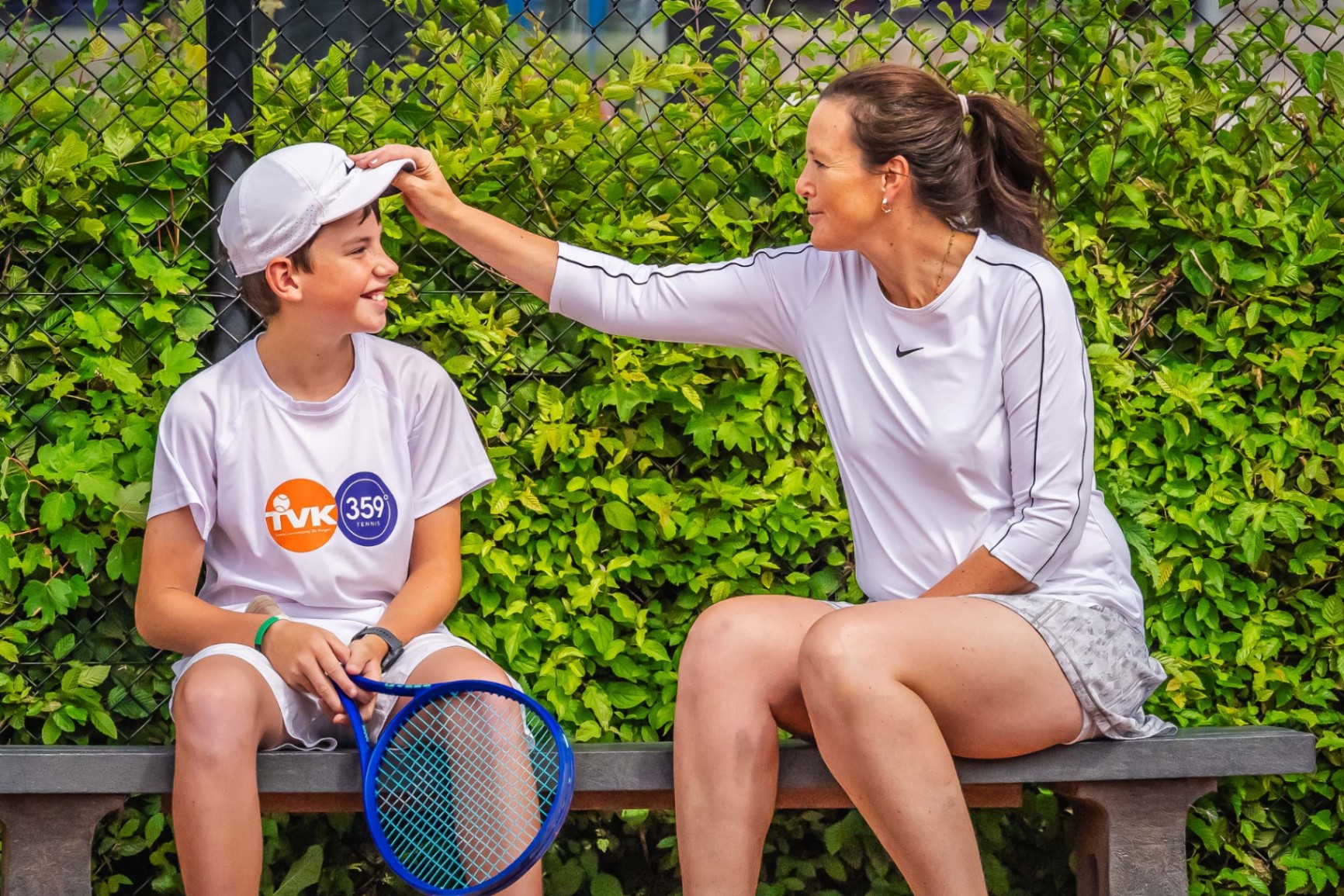
As a parent you have great influence on how your child handles emotions on court. Read also our 359 Parent System document.
- •Don't correct on emotion — 'Behave!' doesn't help
- •Don't say 'Calm down!' — that increases tension
- •Do ask: 'Where was your focus?' — that helps reorient
- •Do acknowledge recovery: 'I saw you came back after that tough point — well done!'
Why is anger a symptom, not the core problem?
Emotions are normal. Everyone gets angry or frustrated sometimes. That's part of competition. But losing your focus — that's the problem. Mental training means learning to return to your task. Progress. Not Perfection.
Key takeaways
- ✓Anger on court is an attention problem, not a character flaw
- ✓Focus on your circle of control
- ✓Use concrete tools: breathing, focus word, friendly eyes
- ✓Parents help by asking about focus, not correcting emotion
- ✓Mental training = learning to return to your task
Want to learn to handle emotions on court? At 359.tennis we train not just technique, but also the mental side of tennis.
Want to learn more about our Parent System?
At 359 we work with a clear parent guidance structure. Read our full 359 Parent System document.